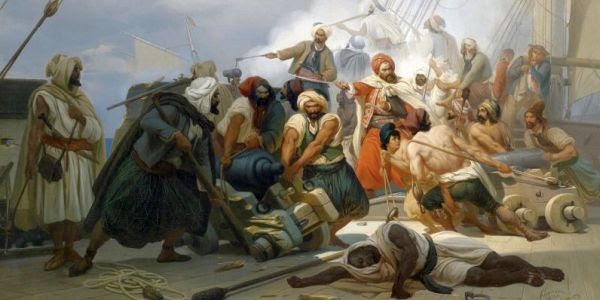
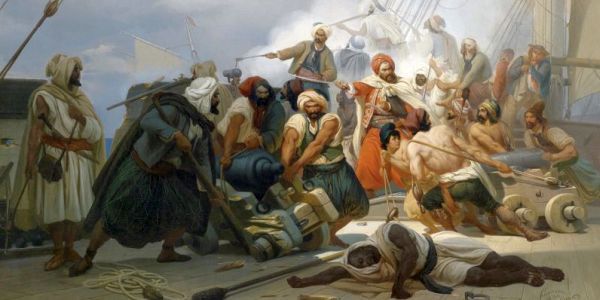
Thousands of Europeans were carried away into slavery by the Muslim pirate Barbarossa, who wreaked havoc in the Mediterranean in the early 1500s, raiding the coasts of France, Italy and Spain.
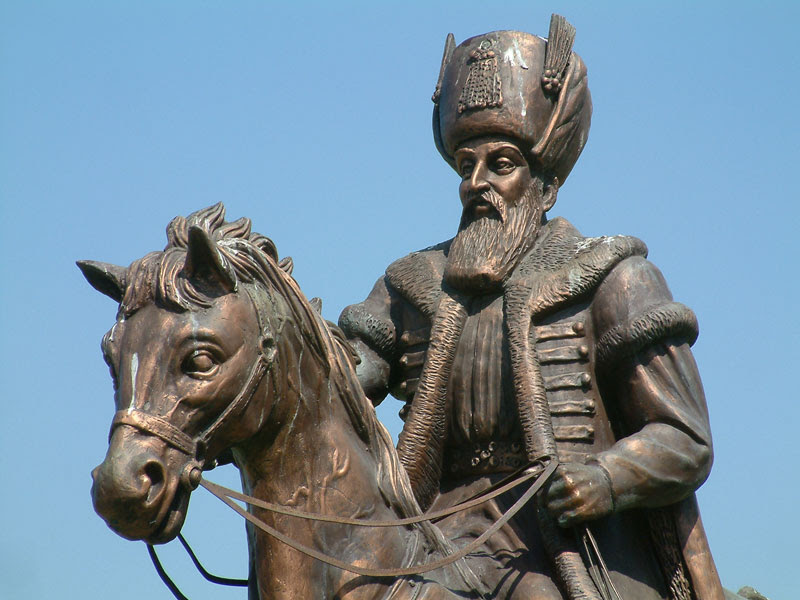
Turks had conquered the Byzantine Empire, and then, under Sultan Suleiman the Magnificent, invaded Serbia, Hungary, Bulgaria, and Eastern Europe.
Suleiman’s armies surrounded Vienna, Austria, in 1529.
Arab, Turk, Mughal, Afghan, Persian, and other Islamic conquerors, such as:
8th century Muḥammad ibn QÄsim;
10th century Mahmud of Ghazni;
12th century Muhammad of Ghor,
killed and subdued tens of millions of Hindus and Sikhs in areas of India, Bangladesh, Tajikistan, Turkmenistan, Pakistan, Iran, Iraq, and regions in the East.
During this time, the Spanish soldier proved to be the most successful champion in defending the countries of Europe, which were collectively referred to as “Christendom.”
King Ferdinand ended the 700 year Muslim occupation of Spain.
Ferdinand’s grandson was King Charles V of Spain, who was also the Holy Roman Emperor, 1519-1556, responsible for defending Christendom.
Using gold from the New World,Spain pushed back Islamic invaders on land and sea.
Spain also stopped Turkish Sultan Ahmad al-Mansur’s ambitions to colonize in the New World, just as the Portuguese stopped the Ottomans from taking over parts of India.
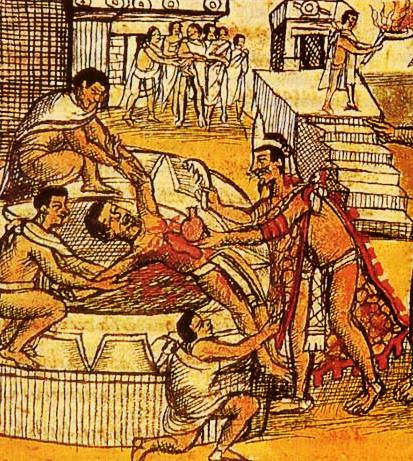
The Aztec religion believed the Sun god needed human blood to stay alive and that it was the Aztecs’ responsibility to daily feed him with sacrificed captives from other tribes.
As the Spanish troops went from town to town, other tribes who had been oppressed by the Aztecs were elated.
They saw the Spaniards as delivering them from having to supply the Aztecs with youths for their sacrifices.
Numerous tribes actually joined with the Spaniards to fight the Aztecs.
He had been shipwrecked on Yucatan eight years earlier and had learned the language:
“So Gerónimo de Aguilar preached to them about salvation, and, either because of what he told them, or because of the beginning they had already made, they were pleased to have their idols cast down,
and they even assisted at it, breaking into small pieces what they had formerly held sacred …
… And soon our Spaniards had left not a whole idol standing, and in each chapel they set up a Cross or the image of Our Lady, whom all the islanders worshiped with prayer and great devotion …
and in thinking that those images, being mute and soulless, made by the Indians with their own hands, were capable of doing good or harm.
He then told them of a single God, Creator of Heaven and earth and men, whom the Christians worshiped and served, and whom all men should worship and serve.
In short, after he had explained the Mysteries to them, and how the Son of God had suffered on the Cross, they accepted it and broke up their idols.
… Thus it was that with great reverence, before a large concourse of Indians, and with many tears on the part of the Spaniards, a Cross was erected in the temple of Potonchan, and our men first, kneeling, kissed and worshiped it, and after them the Indians.”
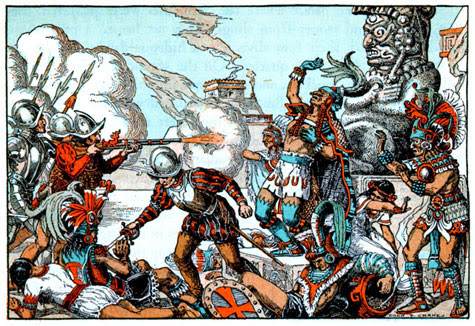
In addition to the advantage the Spaniards had of armor and steel swords, as compared to the Aztec’s clubs, spears, bows, slings, and wooden swords embedded with obsidian or flint, the Spaniards fought to kill whereas the Aztecsfought to capture their opponents for later human sacrifice.
“When Tendile and Pitalpitoque saw us thus kneeling, as they were very intelligent, they asked what was the reason that we humbled ourselves before a tree cut in that particular way.
… ‘It is a good opportunity, father, as we have good material at hand, to explain through our interpreters matters touching our holy faith’
And then he delivered a discourse to the Caciques so fitting to the occasion that no good theologian could have bettered it.
After telling them that we were Christians and relating all matters pertaining to our holy religion, he told them that their idols were not good but evil things which would take flight at the presence of the sign of the cross, for on a similar cross the Lord of Heaven and earth and all created things suffered passion and death;
… that it is He whom we adore and in whom we believe, our true God, Jesus Christ, who had been willing to suffer and die in order to save the whole human race; that the third day He rose again and is now in heaven; and that by Him we shall all be judged.
“It was true that we came from where the sun rose, and were the vassals and servants of a great Prince called the Emperor Don Carlos, who held beneath his sway many and great princes,
and that the Emperor having heard of him and what a great prince he was, had sent us to these parts to see him, and to beg them to become Christians, the same as our Emperor and all of us, so that his soul and those of all his vassals might be saved.”
There was a theater made of human skulls and mortar, wherein Gonzalo de Umbria counted 136,000 skulls, which included those in the steps and on poles.
A tower was made of skulls too numerous to count.
There were obsidian knives, stone altars, black-robed priests with hair matted down with human blood, idols with basins for human blood, walls and steps covered with human blood and gore,
an idol made out of seeds kneaded and ground with the blood of virgins and babies, pits where the human bodies were thrown after people had eaten off the arms and legs.
On July 1, 2017, Reuters published an article “Tower of human skulls in Mexico casts new light on Aztecs,” detailing a recent archeological find:
“A tower of human skulls unearthed beneath the heart of Mexico City has raised new questions about the culture of sacrifice in the Aztec Empire after crania of women and children surfaced among the hundreds embedded in the forbidding structure …
… Archaeologists have found more than 650 skulls caked in lime and thousands of fragments in the cylindrical edifice near the site of the Templo Mayor, one of the main temples in the Aztec capital Tenochtitlan …
Historians relate how the severed heads of captured warriors adorned tzompantli, or skull racks, found in a number of Mesoamerican cultures before the Spanish conquest …
… Raul Barrera, one of the archaeologists working at the site alongside the huge Metropolitan Cathedral built over the Templo Mayor, said the skulls would have been set in the tower after they had stood on public display on the tzompantli …
Such behavior was similar to Canaanite pagan practices in the Middle East until the Israelites drove them out.
Pre-Columbian Central and South America had normalized human sacrifice, as revealed in the report “Archaeologists find the world’s largest ‘mass child sacrifice’ site” (James Rogers, Fox News, New York Post, September 2, 2019):
“Peruvian press agency Andina reports that archaeologists found the skeletal remains of 250 children and 40 warriors at Huanchaco, 346 miles north of Lima.
‘This is the biggest site where the remains of sacrificed children have been found,’ the excavation’s chief archaeologist, Feren Castillo, told AFP.
The children, who were between the ages of 4 and 14, reportedly were sacrificed to honor the gods of the pre-Columbian Chimu culture …”
The article continued:
“In April 2018, the remains of more than 140 children and over 200 llamas or alpacas were found at a 15th-century ritual sacrifice site at nearby Huanchaquito-Las Llamas.
Radiocarbon dating indicated that the remains are from around 1450 A.D., a time when Huanchaquito-Las Llamas was part of the Chimu culture.
The grisly location is near the UNESCO world heritage site of Chan Chan.
In a separate project, experts in Chile have shed new light on how the Inca civilization used ‘trophy heads’ to maintain control over conquered peoples …”
The report concluded:
“At its height in the 16th century, the Inca Empire spanned modern-day Peru, as well as parts of Bolivia, Ecuador and Chile.
Other grisly sacrificial sites have also been uncovered recently.
A vast array of skulls buried beneath the streets of modern Mexico City, for example, has offered a chilling glimpse into Aztec human sacrifice.”
Such preoccupation with skulls is thought to be the origin of the morose Mexican festival DÃa de los Muertos (Day of the Dead.)
“Our Captain said to Montezuma through our interpreter, half laughing:
‘Señor Montezuma, I do not understand how such a great Prince and wise man as you are has not come to the conclusion, in your mind,
that these idols of yours are not gods, but evil things that are called devils and so that you may know it and all your priests may see it clearly, do me the favor to approve of my placing a cross here on the top of this tower.'”
“We told them we were Christians and worshiped one true and only God, named Jesus Christ, who suffered death and passion to save us, and we told them that a cross (when they asked why we worshiped it) was a sign of the other Cross on which our Lord God was crucified for our salvation;
… and that the death and passion which he suffered was for the salvation of the whole human race, which was lost, and that this our God rose on the third day and is now in heaven,
and it is He who made the heavens and the earth, the sea and the sands, and created all the things that are in the world, and He sends the rain and the dew, and nothing happens in the world without His holy will. That we believe in Him and worship Him;
… but that those whom they look upon as gods are not so, but are devils, which are worse, and they could see that they were evil and of little worth, for where we had set up crosses such as those his ambassadors had seen, they dared not appear before them, through fear of them, and that as time went on they would notice this …”
… and how such a brother as our great Emperor (Carlos), grieving for the perdition of so many souls, such as those which their idols were leading to Hell, where they burn in living flames,
had sent us, so that after what he (Montezuma) had now heard he would put a stop to it and they would no longer adore these idols or sacrifice Indian men and women to them, for we were all brethren, nor should they commit sodomy or thefts.
… He also told them that, in the course of time, our Lord and King would send some men among us who lead very holy lives, much better than we do, who will explain to them all about it, for at present we merely came to give them due warning.
And so he prayed him to do what he was asked and carry it into effect.”
The epidemic of smallpox then raging in Cuba, said Governor Velasquez, prevented him from leading the new expedition himself (Bancroft 1883, 9: 358) …”
Donald R. Hopkins continued:
“Narváez left Cuba in early March, and landed at Cempoala, near present-day Vera Cruz, on 23 April 1520.
According to D’Ardois (1961) and Smith (1974), it was an African slave in Narváez’s entourage, Francisco de Baguia, who first introduced smallpox to the American mainland …
Interesting DNA studies propose theories that native American ancestors originated from an isolated group which in millenniums past migrated from eastern Mongolia and Siberia across the Bering Strait land bridge, or possibly sailed across from Southeast Asia through Polynesia.
These ancient travelers to the Western Hemisphere had an isolated gene-pool, whereas inhabitants of Africa and Euraisa (Europe, Middle East, India and Asia) had continual wars, captives, slaves, intermarriages, and migrations, which sufficiently mixed their DNA so as to assure that when a plague occurred, a certain percentage would have immunity.
This was not the case with native Americans, so when Eurasian diseases finally arrived in America, native populations had no immunity and, consequently, were decimated.
Spanish friar, Fray Toribio Motolinia, described the epidemic in his History of the Indians of New Spain (1541):
“At the time Captain Pánfilo de Narváez landed in this country, there was in one of the ships a negro stricken with smallpox, a disease which had never been seen here.
At this time New Spain was extremely full of people, and when the smallpox began to attack the Indians it became so great a pestilence among them throughout the land that in most provinces more than half the population died. (Foster 1950, 38)”
“My brothers, I give many thanks to Jesus Christ to see you now cured of your wounds and free from sickness. I am glad to find you armed and eager to return to Mexico to avenge the deaths of your comrades and recover that great city.
This, I trust in God, we shall soon do, because we have with us Tlazcala and many other provinces, and because you are who you are, and the enemies the same as they have been, and we shall do so for the Christian Faith that we proclaim …”
“The principal reason for our coming to these parts is to glorify and preach the Faith of Jesus Christ …
We cast down their idols, put a stop to their sacrificing and eating of men, and began to convert the Indians during the few days we were in Mexico.
… It is not fitting that we abandon all that good that we began, rather, we should go wherever our Faith and the sins of our enemies call us.
They, indeed, deserve a great whipping and punishment, because, if you remember, the people of the city, not satisfied with killing an infinite number of men, women, and children in sacrifices to their gods (devils, rather), eat them afterward, a cruel thing, abhorrent to God and punished by Him, and one which all good men, especially Christians, abominate, forbid, and chastise …”
“Moreover, without penalty or shame, they commit that accursed sin because of which five cities, along with Sodom, were burned and destroyed.
Well, then, what greater or better reward could one desire here on earth than to uproot these evils and plant the Faith among such cruel men, by proclaiming the Holy Gospel?
Let us go, then, and serve God, honor our nation, magnify our King, and enrich ourselves, for the conquest of Mexico is all these things. Tomorrow, with the help of God, we shall begin.”
The ill and weakened Aztecs were defeated and the great Aztec Empire fell.
Bernardino de Sahagún’s personal history of the conquest, completed in 1585, confirmed:
“Among the Mexicans who fell victim to this pestilence was the lord Cuitlahuactzin, who they had elected a little earlier. Many leaders, many veteran soldiers, and valiant men who were their defense in time of war, also died.”
Though conquistadors greedy for gold and glory treated native people harshly, soon came missionaries motivated by the Gospel, such as Bartolome’ de las Casas, who sincerely wanted to better the condition of Indians.
Bartolome’ de las Casas wrote A Short Account of the Destruction of the Indies, 1542, and Historia de Las Indias, which chronicled the mistreatment of indigenous peoples and convinced the King Charles V of Spain to protect them.
From a broader perspective, the world powers at the time were Spain, Portugal, the Muslim Ottoman Empire and China.
These massive empires had centuries of experience fighting with cannons, gunpowder, muskets, horses, steel swords, catapults, siege machines, and enormous ships.
China’s Ming Dynasty Treasure Fleet, 1405-1433, reportedly had mammoth ships, 450 feet in length, under the command of Admiral Zheng He, during the reign of Emperor Zhu Di, which circumnavigated large areas of the globe.
The peoples of the Americas, through no fault of their own, had none of these advances, not even a wheelbarrow, which had been invented in China over a millennium earlier during the Han Dynasty.
The abundance of wild game and fish in the Americas, to a significant degree, made it largely unnecessary to transition from hunter-gathering to agricultural, which brings technological advances.
It is probable that the New World would have been conquered by one of the world powers of that day, it just happened to have been by Spain.
In 1531, on Tepeyac Hill outside of the former Aztec capitol of Mexico City, the story of Indian Juan Diego and “Virgin of Guadalupe” resulted in an estimate 15 million Indians being baptized in the next 20 years in what many consider the largest mass conversion in history.
#OTD, May 16, 1801, a leader in the anti-slavery movement, who survived an assassination attempt and is responsible for adding a refrigerator to the United States, is […]
#OTD, March 1, 1781, the Continental Congress adopted America’s first Constitution – The Articles of Confederation. Our experiences under these articles were necessary, inspiring the creation of a “more […]

 ‌
‌  ‌
‌  ‌
‌